
The Impact of Solar Panel Soiling on Energy Yield in Commercial Installations
As commercial solar adoption and the transition toward renewable energy accelerate, solar photovoltaic (PV) systems have become a core component of long-term energy strategies for industrial operators, logistics hubs, manufacturing facilities, and large-scale property portfolios. Advances in solar technology, rising electricity prices, and increasingly ambitious sustainability targets have made commercial solar installations an attractive investment for organizations seeking to reduce operating costs, improve energy efficiency, and lower their environmental footprint.
However, achieving the expected return on that investment goes beyond solar panel installation itself. Maintaining peak energy yield throughout a system’s operational lifetime requires ongoing inspection, monitoring, and maintenance.
One of the most significant and frequently underestimated performance-limiting factors is soiling — the accumulation of dust, pollen, industrial particulates, bird droppings, mineral residues, and organic matter on the surface of photovoltaic modules.
Research conducted on photovoltaic modules in the Netherlands highlights that soiling can significantly reduce energy conversion efficiency, with performance losses depending on local environmental conditions, module design, and contamination patterns. The study adds to a growing body of international research demonstrating that unmanaged soiling can materially reduce photovoltaic performance and energy yield.
For commercial asset owners, even relatively small reductions in energy yield can translate into substantial financial losses over the lifetime of a solar installation.
Understanding Solar Panel Soiling
In the solar industry, the correct technical term for surface contamination on photovoltaic modules is soiling.
Soiling occurs when environmental particles accumulate on the glass surface of solar panels. Common sources include:
Atmospheric dust and airborne particulates
Agricultural debris
Bird droppings
Industrial and urban pollution
Mineral residues from water evaporation
Organic growth and biofilms
Pollen
These contaminants reduce the amount of incoming solar irradiance reaching the photovoltaic cells by absorbing, scattering, or reflecting light before it can be converted into electricity.
The Effects of Soiling on Energy Output
Soiling impacts photovoltaic performance through two primary mechanisms:
1. Reduction of solar irradiance at the cell surface
Surface contamination physically blocks and scatters incoming sunlight, reducing the amount of energy that reaches the photovoltaic cells.
2. Thermal efficiency degradation
Studies indicate that localized dust accumulation can also contribute to elevated module operating temperatures by creating hotspots on the panel surface. Since photovoltaic efficiency decreases as operating temperatures increase, this leads to additional performance losses.
The combined effect is a measurable reduction in system output that increases with both exposure time and environmental load.
The Financial Impact on Commercial Installations
For residential systems, a modest efficiency reduction may have limited financial consequences.
However, for utility-scale and other commercial installations, the financial implications of reduced energy yield are significant.
Large rooftop arrays, utility-scale solar farms, and similar installations operate at scale, meaning even minor efficiency losses translate into substantial energy and revenue losses over time.
Research from institutions including the National Renewable Energy Laboratory (NREL) and industry studies consistently indicate that soiling can reduce energy production by up to 25% when left unmanaged. In cases of localized or prolonged contamination, performance losses may be even greater.
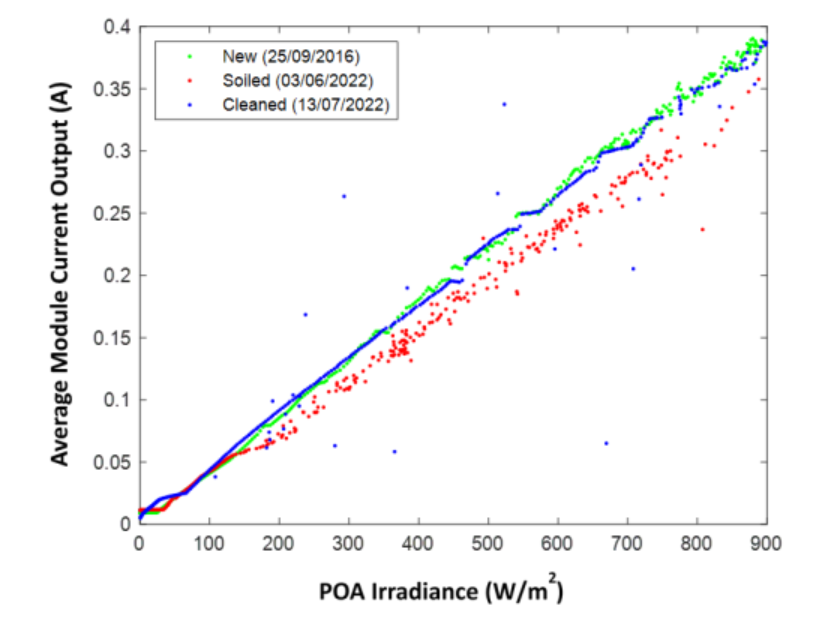
Case Study Report: Solar PV Panel Performance and Soiling Analyses of E.W. Brown Solar Facility:
Comparison of Averaged Module Current Outputs for New, Soiled, and Cleaned Panels.
Commercial installations are particularly vulnerable due to higher exposure to airborne contaminants and extended maintenance intervals driven by scale and accessibility constraints. This combination leads to progressive soiling buildup and increased energy yield losses if not actively managed.
For the vast majority of commercial installations, the financial value of recovered energy significantly exceeds the cost of proactive maintenance.
Beyond financial performance, effective soiling management directly contributes to sustainability outcomes through higher energy yield and reduced carbon emissions associated with electricity consumption.
Managing Soiling in Commercial Solar Installations
While regular cleaning remains the most effective method of managing soiling, advancements in photovoltaic maintenance have introduced preventative solutions designed to reduce contamination buildup between cleaning cycles.
One widely used method is the application of anti-soiling coatings. Depending on the technology, these coatings employ hydrophobic, hydrophilic, or surface treatments to reduce the adhesion of dust, dirt, pollen, and other contaminants to the panel surface.
Although coatings do not eliminate the need for periodic cleaning, they can reduce the rate of contamination buildup and help maintain panel performance between maintenance intervals. For large commercial installations, this can contribute to improved energy yield stability and potentially lower maintenance requirements over time.
To maximize long-term performance, coating applications should be combined with professional cleaning programs tailored to the operating environment and contamination profile of the installation.
Modern Cleaning Approaches for Commercial Solar Installations
As commercial solar installations continue to grow in size and complexity, maintaining optimal performance requires cleaning approaches that are both effective and operationally efficient. Traditional cleaning methods can be labor-intensive, disruptive, and difficult to scale across larger installations and utility-scale systems, driving demand for more advanced maintenance approaches.
Professional photovoltaic cleaning requires equipment, processes, and cleaning agents specifically designed for sensitive solar module surfaces. The effectiveness of a maintenance program depends not only on cleaning frequency but also on the methodology and products used to remove contaminants while preserving long-term panel performance.
At VertiClean Solutions, we employ specialized solar-certified cleaning agents specifically formulated for photovoltaic installations. These products are biodegradable, environmentally responsible, and approved for use with photovoltaic modules manufactured by leading PV manufacturers such as Longi, JA Solar, and Runergy. Combined with deionized water systems and advanced anti-soiling coating technologies, they help remove contaminants effectively while reducing the accumulation of future surface contamination.
For facility managers and solar operators, these approaches offer a more reliable and scalable way to maintain photovoltaic performance while minimizing operational disruption, safety risks, and maintenance costs.
Improving Solar Returns for Commercial Installations
For large rooftop arrays and utility-scale installations, even small efficiency losses can translate into significant cumulative energy and revenue impacts over time.
We provide commercial solar operators with professional photovoltaic cleaning services designed to remove soiling, preserve panel performance, and help businesses maximize the return on their solar investment.
Contact our team using the form below to arrange a site assessment or request a tailored maintenance proposal.
We receive your request instantly and usually respond within a few hours.References
The following research and industry reports informed the findings discussed in this article:
The Dirt on Solar Energy: A study of Dutch solar panel eciency losses from soiling – Talia R. S. Martz-Oberlander (2017), Quest University Canada – https://amolf.nl/wp-content/uploads/2024/11/BSc_thesis_Martz-Oberlander_2017.pdf
Solar Panel Anti-Soiling Evaluation – National Renewable Energy Laboratory (2025) – https://docs.nrel.gov/docs/fy25osti/96625.pdf
Guidelines for Operation and Maintenance of Photovoltaic Power Plants in Different Climates – International Energy Agency Photovoltaic Power Systems Programme (2022) – https://iea-pvps.org/wp-content/uploads/2022/11/IEA-PVPS-Report-T13-25-2022-OandM-Guidelines.pdf
Influence of Dust Deposition on Photovoltaic Panel Performance – Rao et al. (2014), Indian Institute of Science – https://www.sciencedirect.com/science/article/pii/S1876610214011874?via%3Dihub
On the temperature dependence of photovoltaic module electrical performance: A review of efficiency/power correlations – E. Skoplaki, J.A. Palyvos (2009) , National Technical University of Athens – https://www.sciencedirect.com/science/article/abs/pii/S0038092X08002788?via%3Dihub
Energy yield loss caused by dust deposition on photovoltaic panels – Sayyah et al. (2014), Boston University – https://www.sciencedirect.com/science/article/abs/pii/S0038092X1400259X?via%3Dihub
Case Study Report: Solar PV Panel Performance and Soiling Analyses of E.W. Brown Solar Facility – Institute for Decarbonization and Energy Advancement (2023) – https://idea.engr.uky.edu/research/current-research/renewable/CaseStudyReport_EWB_Solar
Anti-Soiling Coatings for Enhancement of PV Panel Performance in Desert Environment: A Critical Review and Market Overview – Hossain et al. (2022), Qatar Environment and Energy Research Institute (QEERI) – https://www.researchgate.net/publication/364552198_Anti-Soiling_Coatings_for_Enhancement_of_PV_Panel_Performance_in_Desert_Environment_A_Critical_Review_and_Market_Overview